
Galaxy projectors turn a plain ceiling into a slow-moving night sky — but they are not all equal, and the cheapest ones tend to disappoint in the same predictable ways. Here is what actually matters before you buy.
What is a galaxy projector?
A galaxy projector is a lamp that casts a moving starfield, and usually a coloured nebula cloud, across your ceiling and walls. The better ones layer two effects together: a sharp field of stars from a laser or LED array, plus a soft, drifting nebula haze. That combination is what makes a room feel like deep space rather than a wall with dots on it.
1. Projection type: stars, nebula, or both
This is the single biggest quality difference, and it is easy to check before buying.
| Projection type | What it looks like | Best for |
|---|---|---|
| Starlight only | Sharp points of light, no colour wash | Small rooms, minimal look |
| Nebula only | Coloured cloud, no defined stars | Ambient mood lighting |
| Nebula + moving stars | Layered depth, slow drift | Immersive "night sky" effect |
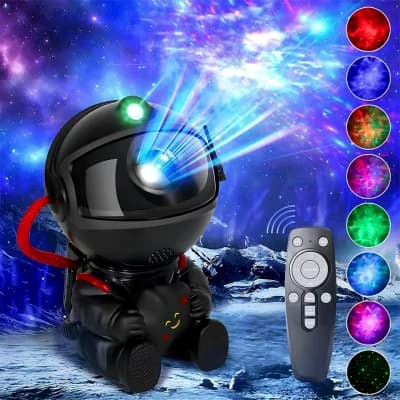
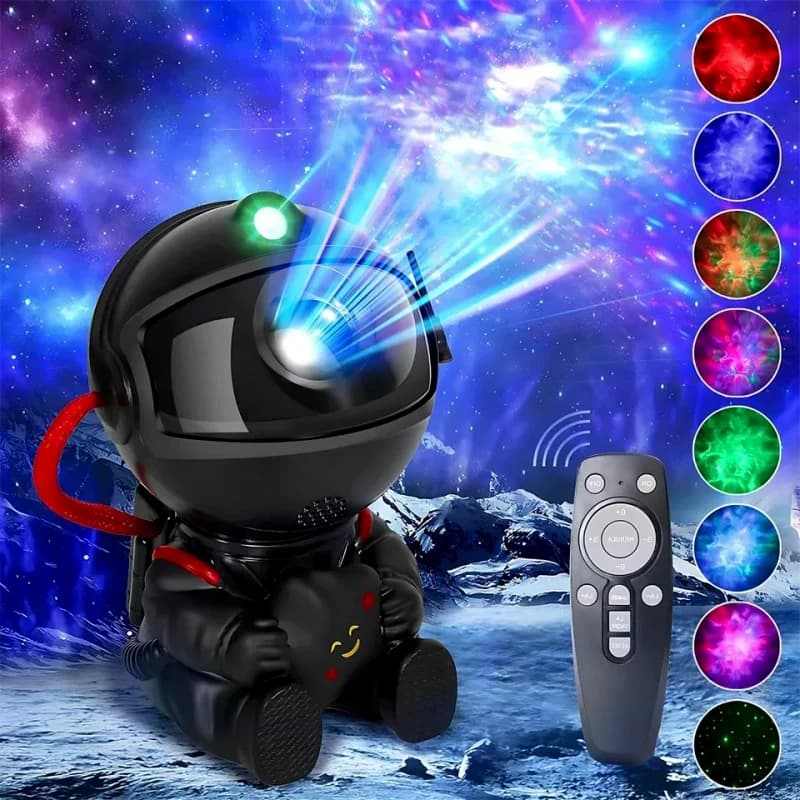
Our Astronaut Galaxy Projector does both, which is why the effect holds up on a full-size ceiling instead of looking flat.
2. Brightness and room size
Brighter is not automatically better. For a bedroom you want adjustable brightness, because a projector bright enough to impress in a living room will keep you awake at 1am. Multiple brightness levels and colour options matter more than raw output. In a very light room, or one with a low ceiling, expect a subtler effect — these are evening devices, not daylight ones.
3. Controls you will actually use
A remote or app you can reach from bed is the difference between a gadget used nightly and one that gathers dust on a shelf. A built-in timer is the underrated feature here: being able to set it to switch off after you have drifted off means you are not waking at 3am to turn off the stars.
4. Design and placement
Tabletop projectors with an adjustable angle are the most flexible — point them at the ceiling, at a wall, or across the room. Give it some distance: most units need roughly 1.5 to 3 metres to spread properly, so a shelf or dresser usually beats a bedside table. A design like the astronaut also works as decor in the daytime, which a plain black puck does not.
Common mistakes to avoid
- Buying on brightness alone. Adjustability beats maximum output for bedroom use.
- Placing it too close to the ceiling. The effect needs throw distance to spread.
- Ignoring the timer. Without one, it either runs all night or wakes you up.
- Expecting daylight performance. These are for a dark or dim room.
Who it is for
- Kids' bedrooms — a calming, screen-free wind-down
- Movie nights and parties — instant atmosphere in seconds
- Anyone who likes falling asleep under the stars
Frequently asked questions
How much should a galaxy projector cost? Entry-level models with a single effect start very cheap but look flat. A dual-effect projector with a remote and timer sits around the £15 to £25 mark — ours is £17.49 — and that is the range where the effect becomes genuinely impressive.
Are galaxy projectors safe to leave on overnight? Use the timer rather than running it all night. Beyond sleep quality, a timer reduces heat build-up and extends the life of the unit.
Do they work in a lit room? Not really. Like any projector, contrast depends on darkness. Draw the curtains and dim the lights for the full effect.
Ready to upgrade your evenings? Browse the Astronaut Galaxy Projector or the rest of our gadgets.